
The Essential Guide to Double-Entry Bookkeeping
Learn the basics of double-entry bookkeeping, including quick tips to understand debits and credits.
Double-Entry Essentials: The Basics
1.1 What is double-entry bookkeeping?
Bookkeeping is the process of recording a business's or other entity's financial transactions. Bookkeeping can also be called accounting.
Double-entry bookkeeping is a bookkeeping method that requires 2 entries for every financial transaction. It is universally accepted as the best accounting method.
1.2 Why use double-entry bookkeeping?
Double-entry bookkeeping has the following advantages:
Clear Audit Trail
Because of its double-entry process, double-entry bookkeeping is the most robust accounting method. This makes it easy to analyse historical transactions and accounts. This makes error and fraud detection much simpler than other accounting methods.
The Accounting Equation
Double-entry bookkeeping ensures that the accounting equation is always in play. Accounts will always balance, and creating a balance sheet requires little effort.
Comprehensive Accounting
This method ensures it covers all financial areas, not just profit and loss. It accounts for assets, liabilities, equity, and cash flow, and you can access them easily.
Regulatory and Tax Compliance
Many tax authorities require double-entry bookkeeping, so this format helps you meet regulatory requirements.
1.3. How to use double-entry bookkeeping?
The easiest option is to use accounting and bookkeeping software that does the double-entry for you. I recommend Xero. Here is a link for 90% off. However, even if you're using accounting software, you must understand the double-entry method.
Double-entry bookkeeping involves recording a business's financial transactions with at least 2 entries: a debit and a credit. Debits and credits must always balance; that is, every transaction's debit value equals its credit value.
For example, a motor vehicle expense of 500 would be debit motor vehicle expenses 500 and credit the bank account 500. But more about this later. There is more to teach you first...
Double-Entry Essentials: Debits and Credits
2.1 Debit and credit basics
Every debit must have a corresponding credit. This is the dual nature of double-entry bookkeeping. But how do you know what is a debit and what is a credit?
A transaction is either a debit or a credit, depending on the financial transaction. Transactions fall into 5 accounting categories: assets, liabilities, equity, expenses, and revenue.
Assets and expenses are debits. There are many ways to remember this, such as DEAD. Debits are Expenses and Assets, Dude. Or PEAD. Purchases, Expenses, and Assets are debits.
Liabilities, equity, and revenue (including sales) are credits.
This is the first step to accounting for a transaction using double-entry. Is the transaction for an asset, a liability, a sale, an expense, or equity?
If you don't know what some of this terminology means, I suggest taking my Free Accounting Course. However, this is a quick explanation:
Debits
Assets are usually tangible items with value that the business buys to use, not resell. These include computers, furniture, motor vehicles, tools, and machinery. They also include cash in bank accounts and money customers owe to the business.
Expenses are the day-to-day costs a business incurs. They include wages, rent, power, stationery, bank charges, insurance, and subscriptions.
Credits
Liabilities are cash the business owes. They include loans, mortgages, credit cards, and taxes.
Equity is money owed to investors and shareholders.
Revenue is money the business receives. This usually comes from sales, but can also include refunds, interest received, and cashback rewards.
2.2 Using double-entry
Let's have a look at some examples. Take a look at the snippet below, which is from a fictitious bank statement:

How would we account for these transactions using double-entry bookkeeping? Let's tackle this one transaction at a time...
#1 The first line is a sale of 500.
When bookkeeping, we need 3 essential bits of information: the date, the account to debit or credit, and the amount. For this transaction, the date is 17th September 20XX. The account will be Sales, as the transaction is a sale. The amount is 250.
Are sales debits or credits? They're credits. So, the first entry of our double-entry is:
CREDIT, 17th September 20XX, Sales Account, 250
This must be a debit. What should be debited? Well, the funds were received into the bank account. The bank account is an asset account, so we debit it. So, the second entry is:
DEBIT, 17th September 20XX, Bank Account, 250.
Our first double-entry is done! Debit the bank and credit sales.
#2 The second line is an expense for fuel.
Debit expenses, and the business paid the money from its bank account. So:
DEBIT, 18th September 20XX, Fuel Expenses, 50
CREDIT, 18th September 20XX, Bank Account, 50
#3 The third line is a bank charge expense.
What do you think? Give it some thought.
The business debited expenses and paid the money from its bank account. What was the date and the amount?
DEBIT, 20th September 20XX, Bank Charge Expenses, 11.50
CREDIT, 20th September 20XX, Bank Account, 11.50
#4 The final line is a repayment of a bank loan.
Is a bank loan an expense, liability, sale, asset, or equity? This is a tough one.
Loans are something that the business owes. Anything the business owes is a liability. Unless the cash is owed to investors, in which case it's equity.
So:
CREDIT, 25th September, Bank Loan Liability, 350
DEBIT, 25th September, Bank Account, 350
2.3 Tips for double-entry
The best thing you can do is to learn your debits and credits. Remember that assets and expenses are debits, and sales, liabilities, and equity are credits; that's a great foundation for double-entry. The easiest way to remember which accounts are debits and credits is by learning the PEARLS acronym:
Purchases, Expenses, Assets, Revenue, Liabilities, and Sales... PEARLS.
PEA are debits (purchases, expenses, and assets).
RLS are credits (revenue, liabilities, and sales).
Another thing, which may sound cliché, is to practice as much as you can. The more you do it, the easier it will be. My Ultimate Bookkeeping & Accounting Course includes downloadable practice assignments that will help. You can also practise on Xero.
2.4 Documents needed for double-entry
To do the bookkeeping, you'll need documents that detail the business's financial transactions and commitments, i.e., those that affect its sales, expenses, assets, liabilities, or equity.
These include current/checking account statements, savings account statements, credit card statements, mortgage statements, sales invoices, purchase invoices, and loan agreements and statements.
Double-Entry Essentials: Trial Balance
3.1 Nominal Accounts
Asset, liability, equity, sales, and expense accounts are called nominal accounts. For example, the sales account, the bank charges expense account, the bank account, the insurance expense account, and the loan account are all nominal accounts.
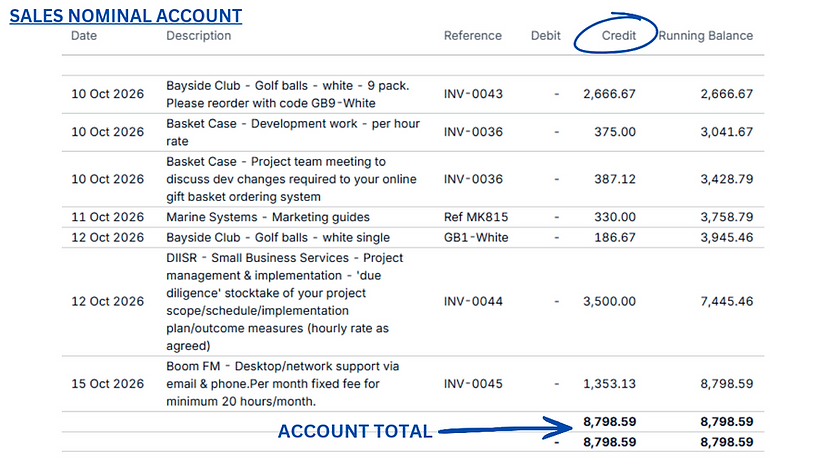
These nominal accounts are totalled to calculate totals for sales, insurance charges, loan repayments, etc. Below is a screenshot of a sales account on double-entry accounting software. You can see the individual entries and the account total. You can also see that each entry is dated and is either a debit or a credit. As these are all sales, the transactions are credits.
3.2 The Trial Balance
The totals of all nominal accounts make up the trial balance.
The trial balance is a financial report that lists all nominal accounts and their debit or credit totals for a specified period.
Below is an example of a trial balance. Can you see the date the report covers? How about the debit and credit totals? At the bottom of the report, you'll notice that the total debits match total credits. These should always match. If not, the bookkeeping has errors.

The trial balance is an important financial report because it helps bookkeepers and accountants spot errors, such as unbalanced debit and credit totals and nominal accounts showing incorrect balances (e.g., an expense account showing a credit total instead of a debit total).
The trial balance is also important because it starts the process of creating financial statements, our next topic.
Double-Entry Essentials: Financial Statements
4.1 The Profit and Loss Statement
The profit and loss statement details the business's sales and expenses for a specified period. Ultimately, it shows whether the entity made a profit or a loss for the period, and by how much.
The profit and loss statement (P&L) is also called the Statement of Comprehensive Income.
You create the P&L by taking all the sales and expense totals from the trial balance. The report lists these to produce the following equation: Sales minus Expenses equals Profit.
If you're super keen, you may know the difference between gross and net profits. However, I will not go into this in this guide. Let's keep it simple.
Below is an example of a P&L statement taken from accounting software.

4.2 The Balance Sheet
The balance sheet is a financial report that details the business's assets, liabilities, and equity at a certain date. It shows what the business owns and what it owes.
The balance sheet is also called the Statement of Financial Position.
The balance sheet is created by taking all the asset, liability, and equity totals from the trial balance. The report lists these to create the accounting equation: Assets = Liabilities + Equity.
Below is an example of a balance sheet taken from accounting software.

Summary
Double-entry bookkeeping is the best accounting method. It involves a credit for every debit, and vice versa. Debits and credits must always balance.
Double-entry bookkeeping makes it easy to create a trial balance. From the trial balance, you can easily create financial statements essential for a business's growth, planning, and taxation.